
The unwrapped evening
Mara had kept the wrapping paper because the reverse was empty. This was not sentimentality, she told herself, but an objection to wasting a perfectly good afternoon hidden inside a sheet of paper. Outside, the last bus made its tired turn beneath her window. Inside, a pear leaned against a cup, and the room waited for her to decide whether the evening had already happened or was still hers to begin.
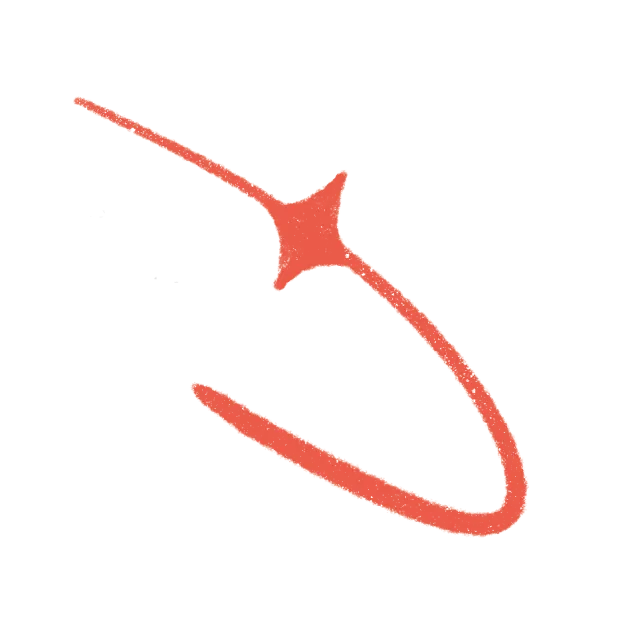
She smoothed the paper across the table, leaving its creases intact. A crease was useful: it offered a direction without insisting upon a destination. Near one corner she drew a small, uneven star, then gave it a tail so long that the star appeared to be arriving late. The comet looked neither grand nor especially astronomical. It looked determined to reach the pear before somebody put the kettle on again.
An improbable visitor
In this invented room, the comet borrowed its beginning from Asteroskoni’s official artwork, but its journey belonged to the evening. Mara tilted the sheet and watched the little visitor acquire a different temperament. Upright, it seemed ambitious; sideways, companionable. She preferred the second version. There were already enough things asking her to become impressive. A companion could sit quietly beside a pear and make no enquiries about what she had achieved.
She added a second line beneath the tail, not quite parallel to the first. The space between them resembled a narrow path seen from a train. Suddenly the comet was not merely crossing the paper; it was making room around itself. Mara followed the lower line with her finger. At the edge she turned it downwards, almost absent-mindedly, as though showing an unexpected guest where to leave a wet coat.
The turning line
The line travelled down, then across, then up the opposite side. It stopped before meeting the star, leaving a small opening through which the whole imagined sky might enter. What had begun as a comet now suggested a frame. Not a stern rectangle announcing that something important had been selected, but an enclosure with its gate ajar. Mara sat back. The blank centre looked unusually attentive, like a chair pulled out for someone.
She considered filling it with a mountain, a face, a tree made magnificent by weather. Each seemed to arrive wearing its own importance. Instead, she looked towards the windowsill. There stood a saucer containing three buttons, a bent pin and the key to a cupboard she no longer owned. She drew the saucer inside the comet’s unfinished boundary. The key, freed from usefulness, looked almost cheerful in its new position.
Things without appointments
The buttons had never belonged together. One was solemn, one jaunty, one so plain that Mara repeatedly forgot it was there. On paper their differences became a conversation. She gave each its proper interval, resisting the temptation to arrange them into a face. They deserved, she thought, an existence beyond being made charming. Even the bent pin could keep its awkwardness. Nothing inside this frame needed to audition for affection.
Beyond the table, the room continued its ordinary business. A pipe knocked. Someone upstairs dragged a chair with the slow conviction of a person rearranging their entire future. Mara drew the cupboard key a little larger than life, then laughed at the phrase. Whose life had supplied the measurement? The key had spent years opening a modest door. Perhaps an invented picture could allow it one evening of unreasonable scale.
A visitor at supper
When her neighbour Ivo knocked, Mara almost folded the paper away. The old reflex was swift: unfinished things should be hidden, especially when they could not explain themselves. But Ivo had brought two bowls of soup and needed somewhere to put them. She moved the pear. He studied the drawing while unwrapping the spoons, then asked why the little star appeared to be supervising a collection of abandoned household objects.
Mara said it was not supervising them. It was keeping them company. Ivo accepted the distinction with the seriousness he usually reserved for choosing a bus route. They ate beside the drawing, careful of the comet’s tail. Halfway through supper he placed his spoon down and pointed towards the opening in the frame. Perhaps, he suggested, that was where the objects went when nobody needed them to mean anything more.
Leaving the gate open
After he left, Mara tried closing the gap with a scrap of spare paper. The picture immediately became more certain and less interesting. The saucer looked catalogued. The key seemed to have been summoned as evidence. She removed the scrap. At once there was somewhere for uncertainty to sit. She had not expected a small interruption in a line to alter the hospitality of the whole drawing, but it did.
She thought of the questions she had been asking herself lately, each demanding an answer with square corners. Where next? What now? How long? The comet offered no advice. Its head remained a slightly lopsided star, its tail an improvised boundary around things already present. Still, Mara found she could breathe more easily while looking at it. For tonight, the questions could remain unanswered beside the saucer and its three buttons.
The borrowed wall
She propped the sheet against the wall, using the pear as a temporary support. From the doorway, the whole arrangement looked wonderfully provisional. The comet seemed to have paused midflight because someone had offered it a seat. Mara switched off the overhead light and left the smaller lamp burning. Shadows gathered along the creases, giving the paper the appearance of a landscape through which the little frame had quietly made its way.
Tomorrow she might redraw it. Tomorrow she might decide that the saucer needed less space, or that the key had become pompous. Tonight she left every disproportion alone. The drawing belonged to a particular hour, with its particular soup and upstairs chair and inconvenient tenderness towards lost cupboards. To improve it immediately would be to interrupt someone halfway through a story merely because their grammar had wandered a little from home.
What the star held
Before bed, Mara wrote a few words on a separate scrap: the first star. She did not mean the earliest star in any sky, nor the beginning of an actual history. She meant the first mark that evening which had persuaded her to look again. A sketch on discarded wrapping paper had become a frame, and the frame had found its subject waiting patiently within reach of her ordinary hand.
In the morning, nothing outside had been transformed. The bus still complained at the corner. The cup still wanted washing. But Mara moved the saucer back to the windowsill with unusual care, giving the three buttons room to remain themselves. On the table, the comet kept its small entrance open. She left it there while she made breakfast, not yet ready to fold the evening away along the paper’s old creases.